Get free quotes from drone inspection near you
Takes about a minute. Free, no obligation; providers reply to you directly.
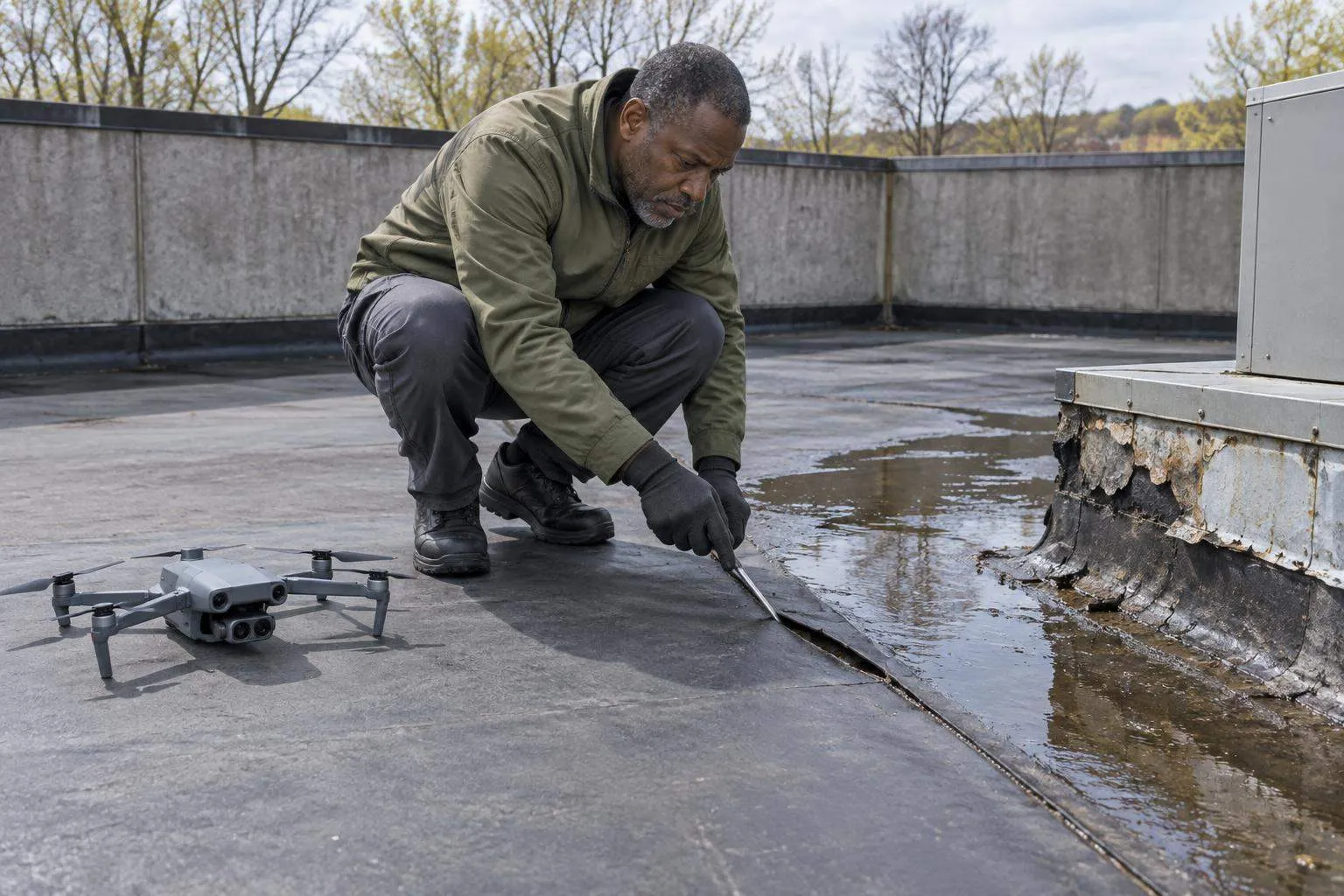
A drone inspector once told me his favorite part of the job was watching a facilities manager’s face when he pulled up a thermal overlay of their roof — eighteen months of “no visible damage” reports, and there it was: a water infiltration pattern the size of a minivan, invisible to every eye that had walked that roof. The damage underneath was $40,000. The drone inspection was $350.
That gap — between what human eyes can see from the ground and what a calibrated sensor at 200 feet can detect — is why drone inspection services have gone from novelty to standard practice faster than almost any other construction and infrastructure technology.
But “standard practice” doesn’t mean “simple to hire.” The market ranges from solo Part 107 pilots charging $150 for a residential roof to enterprise providers running BVLOS fleets over hundreds of miles of pipeline. Knowing the difference matters — a lot.
The Short Version:Drone inspection services use FAA-certified pilots and commercial UAVs to capture data from structures that are expensive, hazardous, or time-consuming to inspect manually. Residential roofs run $150–$400; commercial assets run $400–$1,200+. Always verify Part 107 certification, ask what sensors they carry, and confirm deliverables before you sign anything.
Key Takeaways
- FAA Part 107 certification is the legal floor for all commercial drone work in the US — it’s not optional, and legitimate providers will share their certificate number without being asked.
- Thermal imaging adds 40–60% to the cost of a roof inspection and is almost always worth it — RGB cameras show surface damage, thermal sensors show what’s hiding underneath.
- The five-stage process (scope → plan → fly → process → deliver) separates professional providers from hobbyists with insurance cards.
- Drones are screening tools, not final verdicts — critical defects flagged from the air still need hands-on verification before you commit to a repair scope.
What Drone Inspection Services Actually Do
Here’s what most people miss: “drone inspection” is not one service. It’s a family of data-collection methodologies that share a platform (UAV) but diverge significantly in sensors, workflows, and deliverable types.
RGB/Visual Inspection is the baseline — high-resolution cameras capturing surface conditions. Good for roofs, facades, construction progress documentation, and any asset where visible damage tells the story.
Thermal Inspection layers in an infrared sensor that detects heat differentials. A wet insulation layer under a membrane roof surface reads differently than dry material. So does a hot splice in a power line. So does a missing insulation section in an industrial pipe run. Thermal is where drone inspection earns its keep in energy, insurance, and industrial applications.
LiDAR Mapping uses laser pulses to generate point clouds — precise 3D models of structures, terrain, or worksites. Used for bridge structural surveys, construction volumetrics, and tower geometry analysis where measurements matter more than photos.
Multispectral Imaging is primarily agricultural and solar — detecting chlorophyll stress in crops or efficiency loss in photovoltaic panels by capturing light wavelengths outside the visible spectrum.
The sensors stack. A serious industrial inspection provider might fly RGB + thermal + LiDAR in a single pass. A solo residential pilot probably has RGB and maybe thermal if you pay the premium.
The Five-Stage Process (What Good Providers Actually Do)
This is where you separate professionals from weekend flyers.
Stage 1 — Client Scoping: A legitimate provider starts by understanding what defects you’re looking for, what report format your stakeholders need, and what decisions will be made from the data. Vague briefs produce vague deliverables.
Stage 2 — Planning: Site survey, airspace authorization, flight path design. Providers operating near airports need LAANC authorization before they fly. Providers in controlled airspace near infrastructure need additional clearances. Skip this stage and you’re trusting someone who either doesn’t know or doesn’t care about FAA compliance.
Stage 3 — Execution: The actual flight. Quality providers use planned autonomous missions with calibrated image overlap (typically 70–80% for photogrammetry work) rather than freehand manual passes. DJI’s AI Spot-Check and similar tools lock in consistent framing across repeat inspections, which matters enormously for change-detection workflows — you can’t compare photos if they’re taken from different angles.
Stage 4 — Post-Processing: Raw imagery is just data. Professional deliverables require stitching (creating orthomosaic maps), photogrammetry processing (generating 3D point clouds), thermal analysis (calibrating temperature readings), and anomaly detection. This is where cheap providers cut corners — they hand you a Dropbox folder of JPEGs and call it a report.
Stage 5 — Delivery: Annotated reports with geotagged anomalies, prioritized recommendations, and clear call-to-action items. The best providers deliver within 24–48 hours with findings organized by severity.
Pro Tip:Ask any provider upfront: “What does your deliverable look like?” If they describe a folder of photos, keep looking. If they describe an annotated PDF with geotagged anomaly markers and a prioritized repair list, you’re talking to a professional.
Pricing: What You’ll Actually Pay
Nobody publishes clean rate cards in this industry, so here’s the honest breakdown:
| Service Type | Typical Range | What Drives the Price |
|---|---|---|
| Residential roof (RGB only) | $150–$300 | Roof size, pitch, access complexity |
| Residential roof (thermal) | $250–$400 | Sensor equipment, processing time |
| Commercial roof (RGB only) | $400–$700 | Square footage, building height |
| Commercial roof (thermal) | $700–$1,200+ | Sensor cost, analysis complexity |
| Bulk insurance inspections | $100–$200/property | Volume (10–50 properties per event) |
| Cell tower / utility survey | $500–$2,500 | Asset complexity, safety planning |
| Bridge / infrastructure | $1,500–$8,000+ | LiDAR requirements, regulatory coordination |
| Pipeline / BVLOS survey | Custom pricing | Distance, airspace complexity |
The thermal premium is real and consistent: expect to pay 40–60% more than a basic RGB workflow. That premium exists because thermal sensors cost 3–5x more than RGB cameras, require calibration expertise, and demand more sophisticated post-processing. When it detects a moisture problem that would have become a $40,000 repair, it’s a bargain.
Insurance adjusters have their own market dynamic. After a major hail event or hurricane, adjusters contract drone providers for bulk inspections — 10 to 50 properties per event at $100–$200 each. If you’re a pilot looking for volume work, disaster response contracting is a legitimate growth channel. If you’re an insurer, building those relationships before the next storm hits matters.
Reality Check:Be skeptical of quotes below $150 for any residential inspection that includes a real report. Legitimate providers carry commercial liability insurance, Part 107 certification, and equipment worth thousands of dollars. Someone charging $75 is either skipping the insurance, the certification, or the report — and you won’t find out which until after you’ve paid.
Certifications and Compliance
FAA Part 107 is the starting line, not a differentiator. Every commercial drone operator in the US is legally required to hold a Part 107 remote pilot certificate. Ask for the certificate number and verify it at the FAA’s DroneZone registry. Non-negotiable.
Beyond Part 107, legitimate specialization signals matter:
- OSHA 10/30 training for providers working on active construction sites
- Thermographer certification (Level I or II) for thermal inspection work — operating a thermal camera and actually interpreting the data are different skills
- NBPI or InterNACHI certification for residential inspection contexts
- Industry-specific credentials for oil and gas work, where providers need familiarity with safety protocols, hazardous environment classifications, and reporting standards that go well beyond drone operation
The oil and gas sector is where the “certified pilot with industry knowledge” distinction matters most. A Part 107 pilot who’s never set foot on a tank farm is a liability. Specialized providers who understand H2S environments, explosion-proof equipment requirements, and industry reporting formats are worth the premium.
Equipment: What’s Actually Flying
Rotary-wing drones (multicopters) dominate inspection work — they hover, they’re maneuverable, and they handle close-proximity structural work well. DJI Matrice series, Skydio 2+, and Freefly Alta dominate the commercial market.
Fixed-wing drones cover ground faster and extend flight time significantly, making them better for large-scale linear infrastructure surveys (power lines, pipelines, agricultural land). They can’t hover, which limits their utility for point inspections.
Hybrid VTOL aircraft combine hover capability with fixed-wing cruise efficiency — the emerging platform for serious BVLOS infrastructure work. These are what Energy Robotics and similar enterprise providers use to inspect thousands of kilometers of pipeline from a single deployment point.
The sensor payload matters as much as the platform. A thermal camera that costs $15,000 and requires a certified thermographer to interpret meaningfully is a different tool than a $1,200 consumer thermal attachment. Ask what specific sensor equipment a provider operates — not just “we have thermal capability.”
Where Regulations Actually Bite
Airspace authorization is the practical chokepoint most buyers don’t anticipate. Providers operating near airports, military installations, or controlled airspace need LAANC authorization or a waiver, and some sites have restrictions that can delay or prevent flights entirely.
BVLOS operations (Beyond Visual Line of Sight) require FAA waivers that most small operators don’t hold. The providers running multi-hundred-mile pipeline surveys are operating under specific waiver conditions with additional safety protocols. If a provider claims BVLOS capability without a waiver number, that’s a red flag.
Night operations require a waiver or, under updated Part 107 rules, anti-collision lighting — relevant for thermal roof inspections, which are often most accurate at night when solar loading has dissipated.
State and local regulations layer on top of federal rules. Some municipalities have additional restrictions; HOAs sometimes restrict commercial drone operations over their properties. A professional provider does this research before showing up, not after.
Applications by Industry
Roofing and Construction: The most accessible entry point — roof inspections for general contractors, insurance adjusters, and property managers. Construction progress documentation has become a standard deliverable for large commercial projects.
Utilities and Energy: Power line surveys, substation inspections, solar farm efficiency analysis. BVLOS fleets make transmission line monitoring economically viable at scale for the first time.
Oil and Gas: Pipeline integrity monitoring, tank farm inspections, flare stack surveys. Safety-critical work that eliminates the need to put workers at elevation or in confined spaces.
Bridges and Transportation Infrastructure: DOT agencies use drone photogrammetry to generate 3D structural models for condition assessment — replacing expensive scaffold-and-hammer inspections on assets that need frequent monitoring.
Insurance and Claims: Post-storm rapid loss documentation. Speed matters here; providers who can mobilize quickly after a weather event command premium rates and repeat contracts.
Future Trends Worth Watching
AI-assisted defect detection is moving from marketing claim to operational reality. Machine learning models trained on millions of annotated inspection images can flag potential anomalies in post-processing faster and more consistently than human review — the human expert then evaluates flagged areas rather than reviewing every frame.
Autonomous repeat inspection programs are gaining traction in industrial settings — drones that fly the same route on a defined schedule, automatically comparing current imagery to a baseline to detect change. This is where the DJI AI Spot-Check workflow points.
Regulatory evolution around BVLOS is the unlock that changes the infrastructure inspection market’s economics. As the FAA expands BVLOS authorization pathways, the cost of surveying thousands of miles of pipeline or power line drops dramatically.
Practical Bottom Line
Drone inspection services deliver real value across almost every built asset category — but the range between a $150 residential roof check and a sophisticated BVLOS infrastructure program is enormous.
For property owners and managers: Start with a thermal roof inspection before any reroof bid. The $300–$400 investment routinely identifies damage patterns that change the scope of work and saves you from reroof proposals that miss the actual problem.
For contractors and adjusters: Build relationships with two or three vetted local providers before you need them. Post-storm surge pricing is real, and providers prioritize established clients.
For industrial operators: Require Part 107 certification, industry-specific credentials, documented insurance, and a sample deliverable before awarding any contract. The cheapest bid on a tank farm inspection is not a savings opportunity.
The villains in this story are invisible damage, unsafe access, and the slow pace of manual inspection. A qualified drone inspection provider with the right sensors and a professional deliverable workflow is the plan that defeats all three.
Find vetted drone inspection professionals in your area by browsing our city-level provider directories or reading our complete breakdown of what to look for in a drone inspection report.
Done reading? Get quotes from drone inspection services near you.
Takes about a minute. Free, no obligation; providers reply to you directly.
Popular cities:
Nick built this directory to help general contractors and risk managers find FAA Part 107-certified drone inspectors without wading through generalist photography outfits that added a drone as an upsell — a conflict of interest he ran into when trying to document storm damage on a commercial roof and couldn’t tell which operators carried the commercial liability insurance to back their reports.