Get free quotes from drone inspection near you
Takes about a minute. Free, no obligation; providers reply to you directly.
A roofing contractor called me last spring, furious. He’d hired a drone inspection company for a post-storm insurance claim, paid a premium because their website showed a DJI Matrice 350 RTK — a $15,000+ rig — and got back a PDF of blurry JPEGs with no thermal overlay, no geotags, and measurement data that didn’t align with his adjuster’s report. The drone was real. The operator’s skills were not.
That story is the entire article, really. But let’s get into the specifics.
The Short Version:Sensor type and camera resolution matter far less than you think. What actually determines inspection quality is payload-to-application match, RTK accuracy for measurements, and the software used to process the data. A $3,000 DJI Mavic 3T in capable hands beats a $25,000 Matrice with the wrong payload and no analysis workflow.
Key Takeaways
- RGB + thermal is the minimum viable payload for most commercial inspections; LiDAR is only necessary for 3D deformation or clearance analysis
- RTK GPS (centimeter-level accuracy) is non-negotiable for any inspection where measurements matter — roofing, utilities, structural
- The software platform matters as much as the drone — AI analytics via DJI Terra, Pix4D, or IMGING Detect turns raw imagery into actionable reports
- Confined-space and BVLOS missions require purpose-built platforms, not upgraded consumer drones
The Payload Is the Product
Here’s what most people miss: the drone is just the delivery vehicle. The sensor package — the payload — is what you’re actually paying for.
For standard roof and façade inspections, a high-resolution RGB camera (20MP+) catches corrosion, cracking, and surface degradation. Add a thermal (IR) sensor and you can identify moisture intrusion, heat loss, and electrical hotspots without touching a surface. That EO/IR combination is the workhorse of commercial inspection — it covers roughly 80% of what general contractors, insurers, and facility managers actually need.
LiDAR and SLAM-based payloads generate precise 3D point clouds for deformation mapping and clearance analysis. Useful for bridges, transmission towers, and industrial structures where millimeter-level dimensional data matters. Overkill for a hail damage claim on a warehouse roof.
Gas sensors exist for petrochemical and pipeline work — detecting methane, CO, or H₂S leaks in hazardous environments where a human investigator has no business being. If your job doesn’t involve hydrocarbons, you don’t need one.
Expensive sensors on the wrong mission don’t add value. They add line items.
Platform Comparison: What Actually Gets Used in the Field
| Platform | Best Application | Key Specs | What It Can’t Do |
|---|---|---|---|
| DJI Matrice 300/350 RTK | Heavy-duty exterior: towers, solar arrays, large roofs | Multi-payload bays, RTK, thermal + LiDAR support | Confined spaces; limited indoor use |
| Flyability Elios 3 | Confined spaces: tanks, boilers, tunnels | 4K camera, LiDAR, collision-protection cage | Outdoor in wind; long-range |
| Skydio X2 | Complex autonomous environments | AI obstacle avoidance, repeatable paths | Payload flexibility; heavy sensors |
| Anzu Raptor | Long-endurance U.S. utility inspections | Extended flight time, U.S.-assembled hardware | Confined spaces; portability |
| DJI Mavic 3T | Light commercial, insurance, roofing | Thermal + RGB, portable, fast deployment | Heavy payloads; RTK-grade accuracy |
The Flyability Elios 3 deserves special mention because it solves a problem no other platform addresses cleanly: indoor industrial inspection. Its spherical cage lets it bounce off boiler walls and tank interiors without crashing. Shell’s Energy Robotics deployment proved the concept at scale — automated BVLOS missions inspecting 25-meter storage tanks in 20 minutes versus hours of manual climbing, with AI analyzing roof seal integrity, rainwater accumulation, and grounding cables from the captured data.
That’s not marketing. That’s a climber who doesn’t have to suit up for a hazardous entry.
Reality Check:The DJI Matrice series dominates vendor marketing materials because it’s genuinely capable and DJI has strong distribution. But “they used a Matrice” tells you almost nothing about inspection quality. A Matrice without RTK enabled, without a calibrated thermal payload, and without post-processing software is a very expensive way to take blurry pictures at altitude.
RTK: The Spec That Actually Separates Professional Work
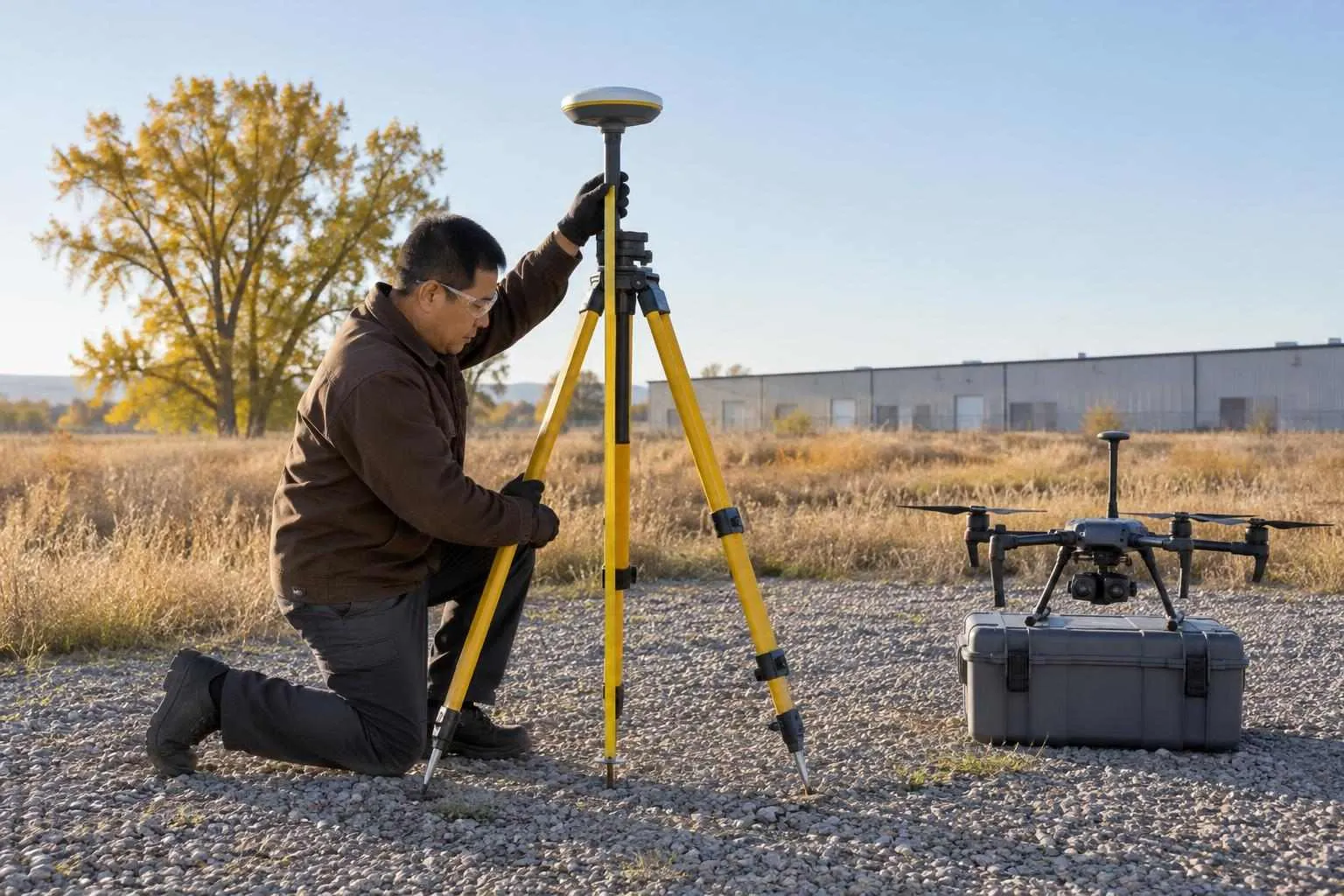
Real-Time Kinematic GPS delivers centimeter-level positioning accuracy. For insurance reports, structural assessments, and any inspection where measurements are cited in a deliverable, RTK isn’t optional — it’s the difference between data that holds up in a claim dispute and data that doesn’t.
Standard GPS drones have 1–3 meter positional accuracy. That’s fine for photography. It’s a liability when you’re documenting hail damage diameter, panel displacement on a solar array, or bridge clearance for a DOT report.
RTK accuracy requires both the drone platform and the base station or network correction source to support it. Verify this before hiring — ask specifically whether RTK was active during the flight, not just whether the drone “has RTK capability.”
The Software Layer Nobody Talks About
Raw imagery isn’t an inspection. The analysis workflow is where the actual value gets created.
Platforms like DJI Terra and Pix4D photogrammetry software convert overlapping drone images into orthomosaics and 3D models with measurable geometry. IMGING Detect uses AI to flag roofing anomalies automatically — reducing manual review time and creating consistent, defensible documentation. Propeller Aero and similar platforms are used in mining and civil construction for volumetric calculations.
A company that delivers raw JPEGs as a “report” is not doing inspection work. They’re doing aerial photography and calling it inspection.
Pro Tip:When vetting a drone inspection contractor, ask what software they use to process deliverables and what format the final report takes. If the answer is “we send you the photos,” walk away. You want geotagged imagery, thermal overlays, anomaly flags, and measurement data — ideally in a format your engineer or adjuster can work with directly.
What’s Mostly Marketing
Megapixel count above 48MP for standard inspections: diminishing returns past a certain resolution. Storage bloat without proportional detail improvement for most use cases.
“AI-powered inspection” as a standalone claim: every major platform has some form of automated anomaly detection now. The meaningful question is which model, trained on what data, with what false-positive rate.
BVLOS capability for jobs that don’t need it: Beyond Visual Line of Sight operations require FAA waivers and are operationally complex. They’re transformative for pipeline and transmission line inspections spanning thousands of kilometers. For a 10,000 sq ft commercial roof, it’s irrelevant.
U.S.-assembled hardware flags: The Anzu Raptor’s domestic assembly matters for federal energy infrastructure contracts with data sovereignty requirements. For most commercial work, it’s a procurement consideration, not a quality one.
Practical Bottom Line
Before you hire a drone inspection contractor — or before you position your own services — run through this checklist:
- Match the payload to the mission. Thermal for moisture/electrical, LiDAR for 3D structural, RGB for visual documentation. Don’t pay for sensors you won’t use.
- Confirm RTK is active, not just available, if measurements appear in your deliverable.
- Ask about the analysis software and what the report format actually looks like before you commit.
- For confined spaces (tanks, tunnels, boilers), verify the operator has a collision-tolerant indoor platform — a Matrice can’t do what an Elios 3 does, regardless of payload.
- Get a sample report from a comparable past project. Deliverable quality tells you more than equipment specs.
The drone inspection industry has moved fast enough that the gear is rarely the bottleneck anymore. Technique, workflow, and analysis software are where quality actually lives.
For a broader look at how drone inspections work across industries, start with The Complete Guide to Drone Inspection Services. If you’re evaluating contractors for a specific project, the city pages linked from there show which operators are active in your area.
Done reading? Get quotes from drone inspection services near you.
Takes about a minute. Free, no obligation; providers reply to you directly.
Popular cities:
Nick built this directory to help general contractors and risk managers find FAA Part 107-certified drone inspectors without wading through generalist photography outfits that added a drone as an upsell — a conflict of interest he ran into when trying to document storm damage on a commercial roof and couldn’t tell which operators carried the commercial liability insurance to back their reports.